ご要望またはご協力できることがございましたらお気軽にお問い合わせください
一般的なお問い合わせと所在地情報
お問い合わせ


From AI ambition to governed execution
How financial institutions can put AI, data, and decisioning to work without losing control of the workflows behind them

An AI decision doesn’t stand alone
An AI model can identify a pattern. An AI agent can recommend an action. But neither delivers a business outcome without a controlled, end-to-end workflow.
In financial services, that workflow may begin with transaction data from a mainframe. It may pull customer or risk data from other systems, run a model in the cloud, initiate a decision, route an alert for review, and trigger a customer, compliance, or operations process.
Every handoff matters.
If data is incomplete, delayed, or inconsistent, the output may not be reliable. If an AI process runs without clear workflow context, teams may struggle to understand what triggered it, what systems were affected, or what action followed. If an exception occurs, someone needs to see it and respond.
91%
of IT leaders call AI-enhanced orchestration extremely or very important.
99%
of financial institutions are testing AI, but only 3% have deployed it enterprise-wide.
AI doesn’t become ready for enterprise use at the point of inference. It requires trusted data, appropriate guardrails, and a visible, coordinated, and governed process around every decision.
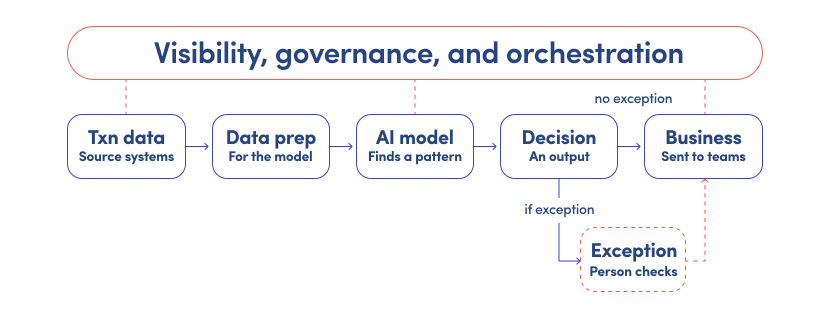
Consider the fraud decision behind a card transaction
A customer makes a purchase. The transaction needs to be approved, declined, or reviewed in seconds.
The fraud model is one part of that decision. The rest is the work that happens around it.
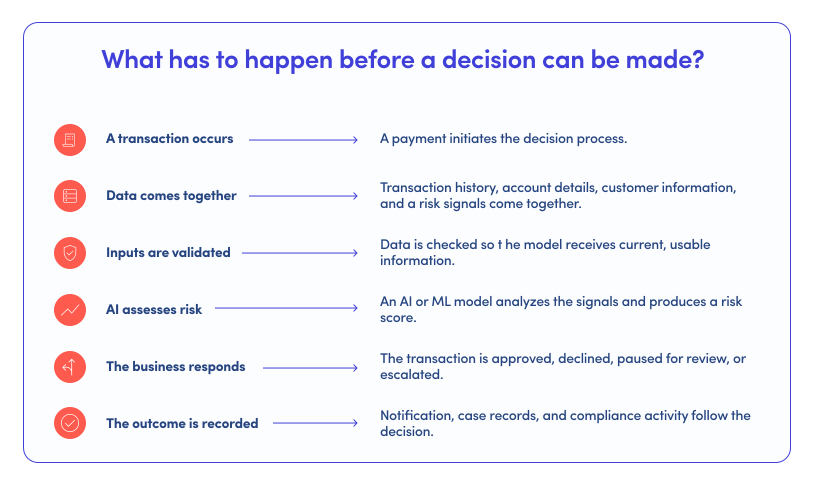
One decision. Many dependencies.
The fraud model can’t work in isolation. Its output is only as reliable as the data, workflow steps, systems, and controls that surround it. Every one of these steps has to run in the right order, on time, every time, in seconds. That coordination is orchestration, and it’s what makes an AI decision dependable in production.
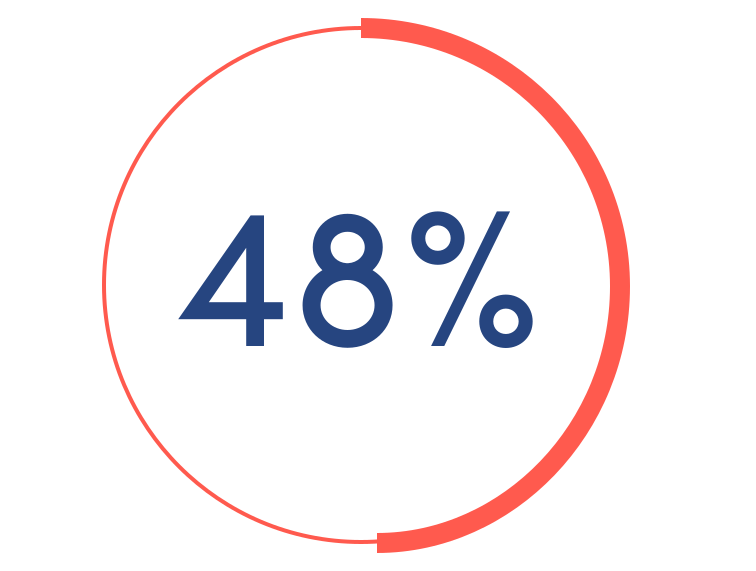
48% of financial institutions name data quality as their top AI/ML challenge, and only 9.5% say they’re very prepared to support AI/ML.3
For financial institutions, speed is not enough. AI must remain connected to the data, systems, controls, and people responsible for every outcome.
Build AI into the operating model
AI is becoming part of the work financial institutions perform every day. It can support fraud detection, risk analysis, customer onboarding, claims processing, financial forecasting, and compliance activities.
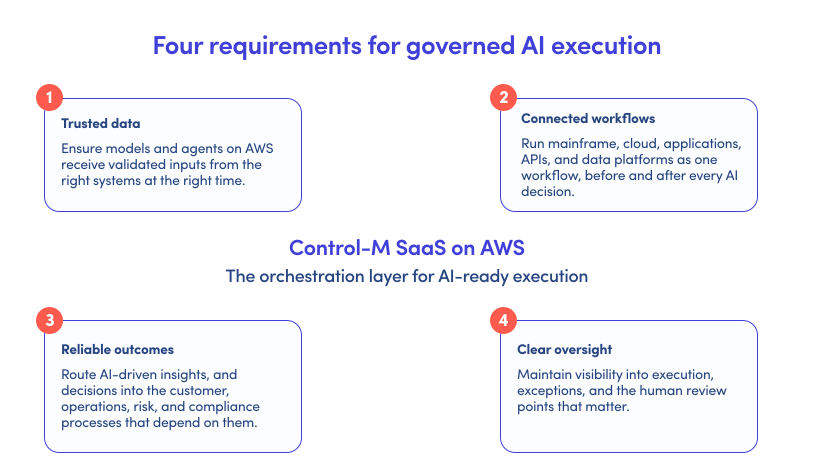
The organizations that scale it successfully will not treat AI as a separate layer of technology. They will connect it to the data, applications, processes, and people responsible for carrying a decision through to a reliable outcome. AWS provides the foundation to build and scale AI in financial services: Amazon Bedrock and Amazon SageMaker to build and run models and agents, and data services such as Amazon S3, AWS Glue, and Amazon Redshift to prepare and serve the data they rely on. Control-M SaaS from BMC runs on AWS and orchestrates the workflow around those services-coordinating the data, applications, infrastructure, and dependencies that move an AI decision into production.
Consider the fraud decision again. Transaction data from the mainframe lands in Amazon S3. AWS Glue prepares it. A model in Amazon SageMaker or Amazon Bedrock scores the risk. The decision moves through APIs into case management, customer notification, and compliance systems. Control-M SaaS coordinates every step as one governed workflow, so each dependency, exception, and handoff stays visible.
ガバナンスされたAI実行を実際に見る。
BMCのControl-M SaaSが金融機関がAIの意思決定の背後にあるワークフローをオーケストレーションするのにどのように役立つかを探る。
- Enterprise Management Associates (EMA), The Future of Workload Automation and Orchestration, as reported by BMC in March 2025.
- Ataccama, Data Trust Report 2025 (financial services edition), October 2025.
- Wolters Kluwer, Q1 2026 Banking Compliance AI Trend Report, February 2026, 148 financial institutions.